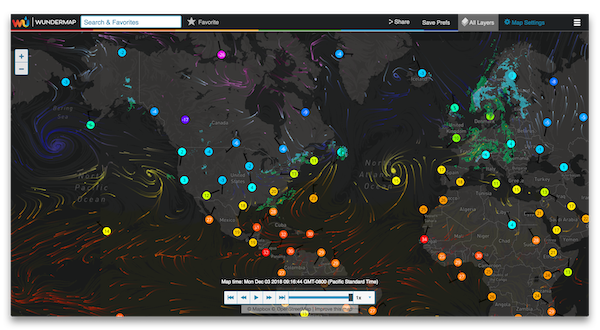
Indonesia is a vast island nation comprised of thousands of islands, large and small, in the equatorial region of both hemispheres in the western Pacific. The largest islands are Sumatra, Java, Celebes and Borneo. Of the 3,000 smaller islands, the best known island is Bali. The larger islands are very mountainous with many large volcanic peaks over 10,000 feet high.
Like most of the western Pacific and Indian Ocean, Indonesia's climate is controlled by the Asian Monsoon. The northeast monsoon blows from November to March, while the southwest monsoon prevails from May to September. During the transition between the monsoons, winds are usually light and variable. This transition zone is known as the Intertropical Convergence Zone and is often accompanied by more concentrated cloudiness and precipitation.
Because of its equatorial location, temperatures are high and do not vary greatly from day-to-night or from month-to-month. The greatest temperature variation occurs with elevation. The higher elevations are much cooler than the lower elevations, however, they tend to be cloudier and wetter. Because of the surrounding tropical oceans, high humidity is a persistent element of the climate, regardless of the time of day or the season.
The combination of high temperature and humidity means muggy conditions prevail. Relief can be sought in higher elevations and near the coast from the sea breeze or strong monsoon flow during the peak monsoon seasons. During the transition seasons, because of the lighter winds, conditions are often oppressive, even at night.
Rainfall tends to be heavy and usually comes in quick hitting thunderstorms, which tend to occur with greater frequency than anywhere else in the world. Rainfall is greater on the south facing coasts and mountain slopes during the southwest monsoon. On the north-facing coasts and slopes, the northeast monsoon is wetter. Jakarta, lying 6 degrees south of the equator on a north-facing coast, shows this single precipitation peak during the northeast monsoon.
JAKARTA, INDONESIA
| Month |
Record Low |
Normal Low |
Normal High |
Record High |
Average Rainfall |
Average # Of Rain Days |
| January |
69°F 21°C |
74°F 23°C |
84°F 29°C |
93°F 34°C |
11.8 inches 300 mm |
18 |
| February |
69°F 21 °C |
74°F 23°C |
84°F 29°C |
92°F 33°C |
11.8 inches 300 mm |
17 |
| March |
69°F 21 °C |
74°F 23°C |
86°F 30°C |
92°F 33°C |
8.3 inches 211 mm |
15 |
| April |
69°F 21°C |
75°F 24°C |
87°F 31°C |
94°F 34°C |
5.8 inches 147 mm |
11 |
| May |
70°F 21°C |
75°F 24°C |
87°F 31°C |
93°F 34°C |
4.5 inches 114 mm |
9 |
| June |
67°F 19°C |
74°F 23°C |
87°F 31°C |
93°F 34°C |
3.8 inches 97 mm |
7 |
July
|
67°F 19°C |
73°F 23°C |
87°F 31°C |
92°F 33°C |
2.5 inches 64 mm |
5 |
| August |
67°F 19°C |
73°F 23°C |
87°F 31°C |
94°F 34°C |
1.7 inches 43 mm |
4 |
| September |
66°F 19°C |
74°F 23°C |
88°F 31°C |
96°F 36°C |
2.6 inches 66 mm |
5 |
| October |
69°F 21°C |
74°F 23°C |
87°F 31°C |
98°F 37°C |
4.4 inches 112 mm |
8 |
| November |
68°F 20°C |
74°F 23°C |
86°F 30°C |
96°F 36°C |
5.6 inches 142 mm |
12 |
| December |
67°F 19°C |
74°F 23°C |
85°F 29°C |
93°F 34°C |
8.0 inches 203 mm |
14 |