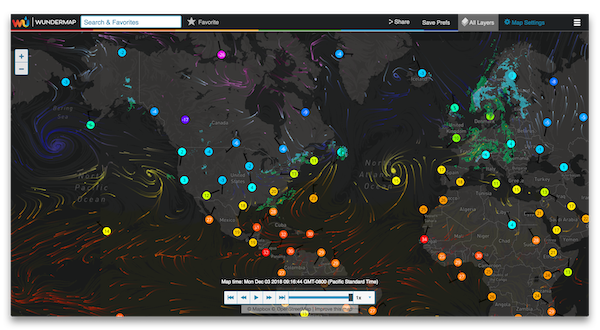
The Current Dewpoint image shows the
dewpoint, contoured every 10 degree F, for the most recent hour. The
dewpoint (or dewpoint) is the
temperature to which a given parcel of air must be cooled, at constant barometric pressure, for
water vapor to condense into water. The condensed water is called dew. The
dewpoint is a saturation point.
When the dew point
temperature falls below
freezing it is called the
frost point, as the
water vapor no longer creates dew but instead creates
frost or hoarfrost by deposition.
The dew point is associated with
relative humidity. A high
relative humidity indicates that the dew point is closer to the current air
temperature. If the
relative humidity is 100%, the dew point is equal to the
current temperature. Given a constant
dewpoint, an increase in
temperature will lead to a decrease in
relative humidity.
At a given barometric pressure, independent of temperature, the
dewpoint indicates the mole fraction of
water vapor in the air, and therefore determines the specific
humidity of the air.
The dew point is an important statistic for general aviation pilots, as it is used to calculate the likelihood of carburetor
icing and
fog, and estimate the height of the cloud base.