Skip Navigation Links
LocalExpand Local
NationalExpand National
GlobalExpand Global
StormsExpand Storms
HealthExpand Health
TravelExpand Travel
CommunityExpand Community
Skip Navigation Links
  Help Hurricanes Alerts
Tomorrow's Forecast
Send this page to a friend
Related Weather Maps
Current Radar
Current Radar
National Infrared Satellite
Infrared Satellite
Forecast Radar
Forecast Radar
Today's Forecast
Today's Forecast
Radar Summary
Radar Summary
Severe Outlook Today
Severe Weather Outlook
Current Surface Analysis
Surface Analysis
Lightning Strikes
Lightning Strikes
Daily Precipitation
Daily Precip
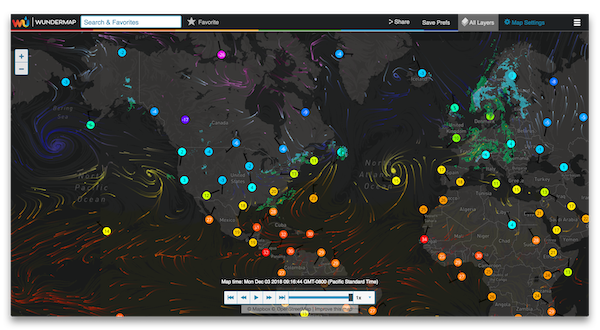
Interactive Map
Interactive Map (BETA)
Advertisement
Tomorrow's Forecast  
Tomorrow's Forecast
Learn about Tomorrow's Forecast View Detailed Information »
Overview
Weather forecasting is the application of science and technology to predict the state of the atmosphere for a future time and a given location. Human beings have attempted to predict the weather for as long as there are records. Today, weather forecasts are made by collecting quantitative data about the current state of the atmosphere and using scientific understanding of atmospheric processes to project how the atmosphere will evolve. The chaotic nature of the atmosphere, the massive computational power required to solve the equations that describe the atmosphere, and incomplete understanding of atmospheric processes mean that forecasts become less accurate as the difference in time between the present moment and the time for which the forecast is being made (the range of the forecast) increases.

Data Collection
Surface weather observations of atmospheric pressure, temperature, wind speed, wind direction, humidity, precipitation are made near the earth's surface by trained observers, automatic weather stations or buoys. The World Meteorological Organization acts to standardize the instrumentation, observing practices and timing of these observations worldwide. Stations either report hourly in METAR reports, or every six hours in SYNOP reports.

Measurements of temperature, humidity and wind above the surface are found by launching radiosondes (weather balloons). Data are usually obtained from near the surface to the middle of the stratosphere, about 30,000 meters (100,000 ft). In recent years, data transmitted from commercial airplanes through the AMDAR system has also been incorporated into upper air observation, primarily in numerical models.

Increasingly, data from weather satellites are being used because of their almost global coverage. Although their visible light images are very useful for forecasters to see development of clouds, little of this information can be used by numerical weather prediction models. The infrared (IR) data however can be used as it gives information on the temperature at the surface and cloud tops. Individual clouds can also be tracked from one time to the next to provide information on wind direction and strength at the clouds steering level. Polar orbiting satellites provide soundings of temperature and moisture throughout the depth of the atmosphere. Compared with similar data from radiosondes, the satellite data has the advantage that coverage is global, however the accuracy and resolution is not as good.

Meteorological radar provide information on precipitation location and intensity. Additionally, if Doppler weather radar is used then wind speed and direction can be determined.

Data Assimilation
During the data assimilation process, information gained from the observations is used in conjunction with a numerical model's most recent forecast for the time that observations were made (since this contains information from previous observations) to produce the meteorological analysis. This is the best estimate of the current state of the atmosphere. It is a three dimensional representation of the distribution of temperature, moisture and wind.
Advertisement
More from Intellicast
More Areas of Interest
Storm Center
Maps displaying current National Weather Service Watches, Warnings and Advisories via County Fill colors.

Current National Weather Service Watches and Warnings by type and state throughout the United States.